Buying Time for a Cure

Bob Patin jubilantly emailed a recent article from the Chicago Tribune reporting progress in human stem cell research – a significant discovery proving that adult skin cells can be cloned to produce embryonic stem cells. But more about that later.

Scientific work like this gives Lori hope that a cure for her Parkinson’s disease is within reach. Parkinson’s is a progressive, degenerative disorder that affects the central nervous system. Until now, there has been no cure, only medications that mitigate symptoms. Lori, in her determined, tenacious way, does not sit back and bemoan the lack; rather she believes her cure is just beyond the horizon. Waiting for that cure to arrive, she works hard at keeping her symptoms at bay by exercising four hours a day, taking harp lessons and having a massage, acupuncture and Feldenkrais® treatment every week, among many other things. Her spirits are good because she knows she is buying time until that cure is found.

Allow me to explain the importance of recent research. First, some basics about Parkinson’s. On a biochemical level, a dearth of dopamine in the brain causes this disease.  Dopamine is a neurotransmitter that sends signals to the rest of the body to control movement, among other things. By the time symptoms manifest, dopamine-generating cells have been 80 percent destroyed.

Stem cell research is critical to finding a cure because scientists believe dopamine-generating cells can be developed from embryonic stem cells. The Michael J. Fox Foundation, for example, supports work in stem cell research for Parkinson’s, disease. MJF funded the original proof demonstrating that ES cells could provide a robust source of dopamine neurons.

The catch is that only embryonic stem cells, not adult stem cells, can do this,Embryonic Stem Cellsand they are not readily available due to ethical considerations about harvesting cells from human embryos. The article Bob sent, “Scientists clone human embryonic stem cells from two adults,” offers the promise of using adult skin cells to clone human embryos specifically for the purpose of creating these critical cells.

There is always hope. Buying time is what matters.


A Message from a Dream

The Book Stall

Two weeks ago I had that dream, the dream that’s most people’s worst nightmare: speaking in front of an audience. (At least I wasn’t naked.) In fact, I woke up feeling great. I had been worrying about what to say and my dream told me. I awoke knowing just how to write my speech. It seemed like a miracle to have my dream do my work for me.

Lori, Bob and I were scheduled to speak about Lori’s Lessons at the Book Stall in Winnetka May 4. I so wanted to do a good job for the Patins that nothing I wrote seemed good enough. The dream dispatch was a gift from my subconscious. It didn’t come as word-for-word text, but as a message to be straightforward, to tell why Lori’s story is so great and to say what a privilege it has been to tell it. This may sound obvious now, but it wasn’t before my subconscious gave me the dream.

I am a great believer in the power of the subconscious. When I was in college, I procrastinated about writing papers. The night before they were due, I would read through all my notes and then get a good night sleep. When I woke up, I would sit down at the typewriter and type my paper like magic. While I slept, my subconscious organized all the material, figured out what was most important and tied it all together.

My main problem with speaking about Lori’s Lessons was getting started. I usually open by telling of the blessings the Patins have brought to my life. Between the time that we set up our first meeting and the time we met, my daughter was diagnosed with epilepsy. Lori’s story, her wheel of attack against her disease, has helped me teach my daughter how to stand up to her neurological disorder. Bob’s words of wisdom about caregiving have inspired and strengthened me as I care for her. My daughter gave me permission to tell her part of the story in the book, but I knew she would not want me to discuss it when she was in the audience. That caveat had blocked me from writing the talk I wanted to give. My dream straightened me out: I didn’t need to tell my story.

I love a book by Rollo May entitled The Courage to Create. In it, he said: “The value of dreams…is not that they give a specific answer, but that they open up new areas of psychic reality, shake us out of our customary ruts, and throw light on new segments of our lives.” You just have to be ready to receive the message.

This book about Parkinson’s is not about Parkinson’s

kilt

Although the subtitle of Lori’s Lessons is What Parkinson’s Teaches about Life and Love, it isn’t really about Parkinson’s disease. Parkinson’s is just the platform for Lori’s attack on the most difficult problem of her life. I first learned this two years ago when Bob emailed me about writing the Patins’ story.   He said: “It isn’t really a story of Parkinson’s but a story of fighting anything thrown at folks and the kind of attitude, help and processes that all combine to deal with any challenge. Parkinson’s is just the platform.”

If I had to sum up all that I admire about Lori in one word, that word would be attitude. Her attitude is remarkable. She is absolutely forthright about telling people her limitations and needs but is never a drama queen. She doesn’t feel sorry for herself. She is determined to make the best of her life and if she doesn’t find the right way to do it the first time, she will find another way. “I am absolutely determined that this is not going to get to me. I will not let Parkinson’s control my life. My destiny is still in my own hands.”

Bob explains, “I was trained long ago in the world of work that you can use any situation to your advantage if you approach it the right way. In this case, with Parkinson’s, we say to ourselves, “We acknowledge that this is ugly, but how do we actually make it work for us?” How do we force ourselves to get into a mindset that says that we can turn this ugly situation to our advantage by thinking about it creatively?”

Lori has thought really creatively and draws upon every resource to take
a 360-degree approach to her problem. Her attack on Parkinson’s is like a wheel crushing down on the enemy. She uses medicines (the rational approach), the spiritual approach, friends and family (the community approach), diet exercise and sleep (the physical approach) and the assistance of caregivers.

Do Not Go Gently

Chuck Berry

Last night I took my husband Jake to Blueberry Hill for his birthday. We were able to see Chuck Berry perform in the Duck Room after trying to get tickets for five or six years. Since Chuck performs only once a month, you have to gp online immediately as soon as sales start to buy tickets. It was worth the wait: Chuck is 87 and still rockin’ and rollin’. I loved his music when I was a teenager and he was wild and free. I loved him yesterday too. This is certainly a tamer Chuck than the guitar legend. We sat front-row-center and could see how management puts a list of songs with keys in huge letters on the floor. He got the key wrong once anyway to the annoyance of Charles Berry, Jr. who performs along with his Dad and sister Ingrid. Right key, wrong key, April 23rd was Chuck’s 203rd consecutive performance at Blueberry Hill. How cool is that?

A lot of people his age would be resting on their laurels with their feet up in front of the television. Instead he is singing and playing the guitar for over an hour, sweating under the hot stage lights. Even putting one foot out and sliding on the other in a modification of the dance he pioneered – the “Duck Walk.”

That’s why I admire Lori so much. Like Chuck who won’t let the diagnosis of advanced age put him out to pasture, she is living her life to the fullest despite the diagnosis of Parkinson’s.  When she first heard she had the disease, she says, “I felt like I just wanted to sit in a corner and cry until I died.” Then something powerful happened. She realized Parkinson’s would never kill her, so she determined to make the absolute best of her life. And she has. “I can choose to not let this get to me. And, if it does, then I can figure out another way to fight. And another way after that. I can beat this.”

Big Sleep

sleep-stages

Sometimes my husband and I come home from a party just as my children are going out. Well I remember being young and staying out late. Now, in the prime of my middle age, I cannot imagine anything worse. As far as a mood elevator, a good night’s sleep is my drug of choice.

I have made some radical changes in lifestyle in the last ten or twelve years to support my sleep habit. The most difficult change was giving up coffee. I do love a good cup of java. In the old days, coffee was my reason for getting up in the morning. But I read an article that said I would lose ten pounds if I switched from coffee to green tea. (I did lose nine pounds, but that’s another story.) The first two weeks I had terrible headaches. Caffeine is a vasodilator so I guess all the veins in my brain were constricting. Nevertheless I persisted coffee-less because I realized the immediate benefit of not waking up to pee so often. How sweet it is to sleep through the night.

Another change I made is going to bed at the same time every night and getting up at the same time every morning. I clock out between nine and ten and bound out of bed between five-thirty and six. Too early for most, but it works well for me. I sleep so much better than the old days when I would stay up past midnight and then try to sleep in. Light and noise just interrupt my shuteye once the day dawns.

Lori puts a high priority on sleep too. It is one of the spokes of her wheel of attack on Parkinson’s. Parkinson’s Disease messes with sleep big time. P.D. can cause R.E.M (Rapid Eye Movement) Sleep Disorder that creates unique sleep disturbances where people act out their dreams. To them, their dreams are real. When people have this symptom of Parkinson’s dream, it’s not passive. In Lori’s case, sometimes she talks a lot; others she does what she is dreaming. Bob says, “Once I woke her up because she was choking me with the chord from my sleep apnea device. When I asked her why, she said, ‘You’re the dog. I am taking you for a walk.’” It was nothing personal.

Lori’s Parkinson’s specialist, Dr. Michael Rezak, said his patients who do everything right live well longer – everything right means: getting exercise, taking meds and sleeping well. Lori works hard to get enough sleep: “I need a really good night’s sleep so I oftengo to bed at nine. It’s not even dark in the summer. I try to get eight to nine hours a night. If I get eight hours, I am in fine shape but nine is luxury. I take a half hour to finallyget up so I try to wake up slowlyand start flexibility exercises in bed. When I get up really slowly, then I am alsoless likely to have breathing or balanceproblemsas the day begins. As with most people,I am not fullyrested if I don’t get enoughREM sleep.”


Mind Games and Food for Thought


My father died form Alzheimer’s and now my mother has dementia. With this genetic inheritance, I read everything I can about taking care of your memory. Yesterday I posted a list of foods that improve memory: salad oil, fish, dark-green-leafy vegetables, avocados, sunflower seeds, peanuts, red wine, berries, and whole grains. I was mildly shocked because I eat all these foods except sunflower seeds as much as I can because I like them. Better double down on sunflower seeds.

I also do Sudoko every day. Research says Sudoko and crossword puzzles make new memory connections. “My guess is that playing them activates synapses in the whole brain, including the memory areas,” says Marcel Danesi, PhD, author of Extreme Brain Workout. Whereas scientists used to believe brain development was static after a certain age, they now recognize neuroplasticity –  the brain can develop new pathways. Games and memory exercises encourage neuroplasticity.

Lori is well aware that Parkinson’s can lead to memory problems so she exercises her brain just as she does her body. She says, “To exercise my memory I play bridge twice a week for three hours at a time. And that has helped a lot because there is so much memory in the game. When I was in the hospital, someone brought me Suduko, a game of number patterns. That’s good for your memory too. I do more reading than I used to, which also helps me with words I can’t come up with. I went to a store called Marbles that sells games, mental exercises and other tools for your mind. I bought a memory game that is about an art auction where different things are auctioned off and they are all pre priced.   You have to remember what the pre price was and what the final auction price was. All of these may not protect my ability to function intellectually, but they surely seem to help. And, you know what? They’re fun. I’ve learned that if I can make mental exercises fun, I’m far more likely to do them.”


Physical exercise is good for your brain

Tai ChiI learned long ago that I think better after I exercise so I do my best to get some form of vigorous activity before I write. I try to exercise every day, but many weeks I can only do six days. Three times a week I practice a workout routine with a half hour on the bike, plus weights, crunches and stretches. I mix it up with yoga, tennis and three-mile walks with friends. I feel like it gets the blood pumping to my brain.

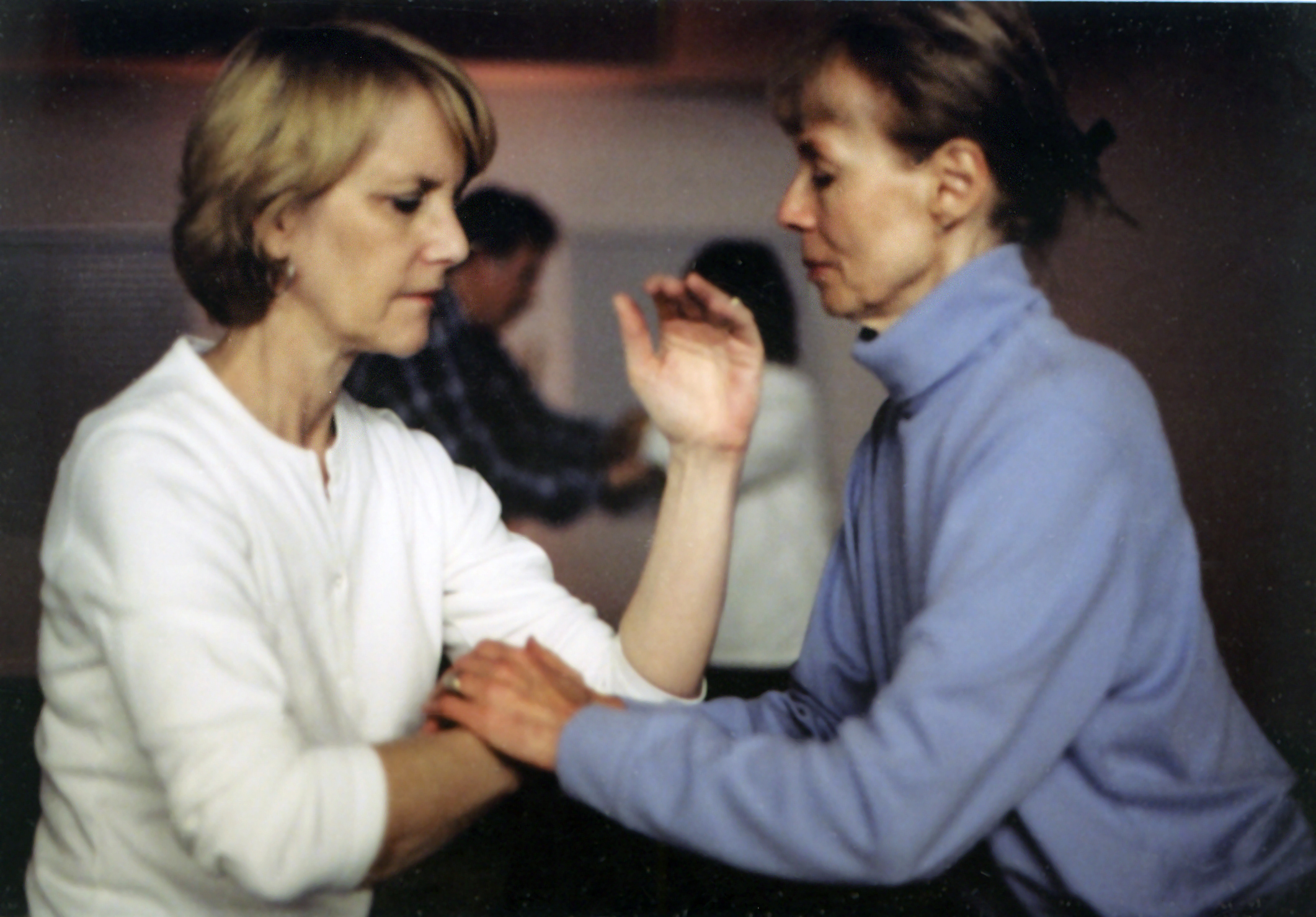
Since I figured this routine out myself, I was deeply interested to learn that exercise is a key part of Lori’s attack on Parkinson’s. Her specialist, Dr. Michael Rezak, says that Lori’s exercising has definitely slowed the progress of the disease. Lori dedicates four hours a day to exercise. She stretches when she gets up. For endurance and strength, she walks on the treadmill and lifts weights. Ballroom dancing and tai chi improve balance. Lori plays the harp develops finger control so Lori can help prevent the trembling hands that are a symptom of her disease. As a former aerobics instructor, all this comes naturally to Lori. While P.D. has taken away many things she liked to do, like biking, skiing or roller blading, but she is so much better that she can play golf again.

We were pleased to read that Dr. Dennis Keane, physical medicine and rehabilitation physician, thinks a dedicated exercise program will not only control the symptoms of Parkinson’s but may slow its progression or even prevent its manifestation. He says, “Our brains have neuroplasticity. That is, with activities such as exercise, we stimulate our brains to create new nerve pathways to take over the role of what we may have lost from a neurological disorder.”

I have Alzheimer’s in my family. I hope the same goes for Alzheimer’s.


The wheel of life

Lori and I talked a great deal about how she thinks about fighting Parkinson’s. She fights it with her whole life – mind, body and soul.  While that is a very hard concept to wrap the mind around, the best way she could make me understand was the metaphor of a wheel.  All of her efforts combine to crush down on her enemy with the rim of this wheel. Every spoke of the wheel contributes to the crushing power of the rim to fulfill Lori’s goal of living a full, normal, joyful and healthy life.  Lori’s wheel has five spokes: medicine; friends and family; caregivers; exercise, diet and sleep; and attitude and spirituality.  The beauty of this metaphor is that all five spokes work together.  There is no hierarchy; each spoke is as important as all the others.

My daughter who is training to teach yoga was really taken by this metaphor. She explained that yoga teaches a wheel of life broken into eight parts.  It is important to have all eight parts in balance.  Although Lori talks about five parts, there are really eight. One spoke is friends and family, another exercise, diet and sleep.  If you separate those, Lori’s wheel has eight parts too.

Moreover, Lori’s eight-fold wheel has parallels with the yoga wheel. For the yoga wheel’s recreation, Lori’s wheel has exercise.  For community, Lori has friends.  For health, eastern and western medicine; for relationships, family; for personal growth, attitude; both have spirituality.  They differ in that the yoga wheel has career and money while Lori has diet and sleep. That is quite a substitution.
PastedGraphic-2 copyPastedGraphic-4 copy

Just Begin

MandalaStarting is always the hardest part of writing anything.  I had this great, inspiring story, but how to tell it?  I was lucky enough to spend lots of time with the Patins.  I got to stay at their house and interview their daughters.  I met their closest friends and their pastor.  I had pages and pages of notes, tape-recorded interviews, research on Parkinson’s and memories of times spent together.  A mass of material.

How to give it form?  How to present it so it grabbed the reader and didn’t let him down until he finished the book?

Over the years, the Patins have come up with a coherent method to fight their enemy, Parkinson’s.  It is so coherent that it translates to any major life challenge.

Yet I was certain this was more than a how-to book.  Lori ‘s story is so much richer than a step-by-step guide to holding P.D. at bay.  She is so modest that she would never presume to tell people how to change their lives.  She offers up the details of her struggle hoping that people will think: If she can do it, so can I.

It wasn’t just a memoir either.  While Lori’s life story is integral to the book, it is not just about Lori’s life.  Organizing the material along the timeline of Lori’s life would hide the real meaning of this story.

And then I had to include the lessons.  Lessons kept coming up again and again.  Bob said, “This disease is a teacher and both Lori and I have surely struggled with some of the lessons, but we have learned the hard ones.  The harder they are, the more we learned to team up against the challenge.”

How to combine all these themes?  The best way is to get off to a good start and set the form.  I thought and thought and decided to write the way I would tell a friend.  I kept coming back to an idea Lori told me early on: she thinks of a wheel when she conceptualizes her fight against Parkinson’s.  So I started off by setting the story straight, the way I would to a good friend, and then began to write about the wheel of Lori’s life.  The lessons just fell into place along the way.

Lesson 20: Why Me?

9781491702178_COVER_FQA.inddPatins – Caregiving

Sometimes I have a down day when I struggle with the many responsibilities of caregiving.  Then I feel sorry for myself because my life seems consumed by my new duties.  It is not a pretty way to feel, and I am not proud of myself when I indulge in self-pity.  Ordinarily exercising lifts my spirits if I feel a little down, but recently I had a cough that kept me out of the gym.  I had to find other means of chasing away the blues.  So, I turned to the lessons in the back of Lori’s Lessons and then spent some time talking to a friend.

I draw great comfort from Lesson 20: The biggest challenge for your caregiver is: to hate the disease, really loathe it, but not resent the person who has it.  He or she may know intellectually that it is not your fault, but every caregiver has moments of thinking: “Why me?  What did I do to deserve this?”  They have to set that aside and move on, for themselves as much as for you.  Still, to underestimate the challenge of dealing with their emotions would be not only naïve but potentially destructive.

            I feel so small and petty when I feel sorry for myself, but reading that every caregiver goes through this comforts me.  Also I found the advice about not repressing these emotions very helpful.  Pretending these emotions don’t exist could be destructive.  If I deal with them, I will be able to move on.

So I spoke with a wise friend and told her about my emotional struggle.  She lost her mother a few years ago and took very good care of her while she was dying.  She told me it was often painful, but now she is so glad she was able to be present for her mother at that point of her life.  The experience has deepened my friend and given her many tender moments to reflect upon.   I felt so much better after being reminded to consider the beautiful times my mother and I have together.