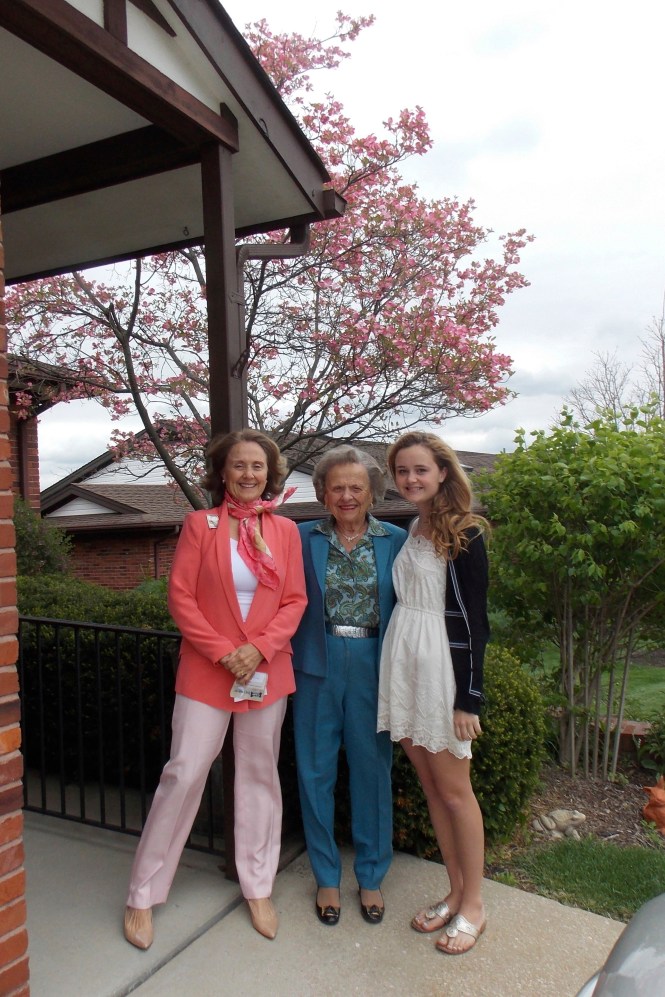
Life is so wonderful. I have been caring for my mother who has dementia. I posted a blog about a conflict she and I were having. She wants her jewelry but her assisted living facility will not allow it on the premises. I received two wonderful and thoughtful replies. I needed help, and my friends gave it to me. I am so grateful. I am going to print their letters in their entirety as well as lesson fifteen from Lori’s Lessons.
Lesson 15: Accepting help is not a sign of weakness but of strength. It takes strength to accept your limitations and to allow someone to assist you. To ask for and receive help requires the powerful combination of humility and courage.
Letter one:
I read your poignant post regarding your Mom ON FB. My Mom too had AD until she passed away in 2007. I’ve also had many patients with it. [My friend is a neurologist.] Your comment “hate the disease, love the patient” was so right on. Even later in the disease, when Mom could barely talk, our psychic emotional bond was such that we just enjoyed sitting together very peacefully. However, there is a point when even that level of communication is gone and you realize you are just looking at an empty shell………………..
There are so many phases to this disease – good and bad – but no matter how awful they are, they all pass. As an example, the very peaceful phase with my Mom described above was late in her course. Early AD sufferers may go through a very unpleasant paranoid spell which sounds like your Mom’s present state. She may believe you are stealing from her, attacking her (my Mom would only let me give her IM sedation in the hospital), that her husband is an imposter, that you are deserting her (“Don’t leave me here,” which is the worst), etc.
BUT one way to deal with it – for her well-being as well as yours – is to lie. That sounds horrible and harsh but it is an important act of kindness. It may be the only way to make her memory loss work in your favor. You have to be creative. With her jewelry you could say something like, “Don’t you remember going over to my house with me last night and putting it in the ____ for safe keeping? If you want it back, I can bring it back tomorrow.” Hopefully she won’t remember tomorrow, but if she does you could say YOU forgot!
You may be able to get away with this for several days because she may not remember the previous day’s discussion. It is not mean or evil: it may give her a great deal of solace and peace of mind.
The subject may change. Like, “Where is so-and-so?” “He just left but is coming back.” You have to be creative and judge what she’ll accept. Remember: this is just another phase that will eventually pass.
You may also work with a phenomenon called “confabulation” which occurs in any type of dementia. At some level the individual may want to “save face” and not admit that she’s forgotten something. For example, to demonstrate the profundity of someone’s dementia – who seemed superficially intact – to students on hospital rounds, I might say to the patient, “How did you like that movie we went to last night? Wasn’t it great?” The patient – who never left the hospital – may agree and maybe even elaborate on the subject.
No one likes to be untruthful or “play games” with a loved one but, remember, she is probably not understanding the content of the discussion – like “your jewelry is safe” – but she will relate to the associated emotion – in your face, your tone, etc. Try to keep it upbeat and happy no matter you are telling and she’ll feel much better. (And so will you.) No matter how hard you try, you can’t MAKE her understand, but you can convey that everything is ok. You can make her happy even if things are grim.
My Dad died of prostate cancer in the same nursing home 3 months before my mother died. Mom was mute and incapable of any communication at that point. I did not think she could comprehend the fact of his death. But I did believe that if I told her I would somehow convey terrible emotions and she would be upset without knowing why. It was an excruciating decision not to tell her.
These are my insights I offer you. These were my coping mechanisms. You’ll find your own but I hope this helps. This is so very personal. I am an only child who had 2 dying parents – who I loved beyond love – in the same nursing home at the same time.
Letter two:
Carol, I am so sorry for you and your whole family. My mother passed away in April from this horrible disease that slowly takes your loved one away. I’d like to pass along something that someone shared with me … Along the way I felt awful about not being truthful with her … Like having to leave her for the night and she would want to come with me but I would tell her I would be right back.
As I walked out of her room one night a nurse saw me bawling my eyes out as I walked down the hall. She asked me what was wrong and I said I felt awful lying to my mother so much lately to get her to do things. I felt like I was lying like it was my job. She said to not worry, that it was OK because we call them “Loving Lies”.
At that moment I felt a sense of relief and very grateful that she passed that on to me. It helped my whole family be able to not feel so awful lying and having to trick her into things.
We laughed a lot too and when she would get agitated I always told she was so funny and that she could have ice cream or popcorn to get her to do things she wouldn’t do.
Even after I got her into the shower by bribing her, she wouldn’t remember afterwards about the ice cream. I would give her the ice cream anyway and she would just beam like a little girl.
Take care of yourself Carol … I know you’ve heard that a million times but it is not only emotionally and physically exhausting it is mentally exhausting trying to keep things for them as calm and peaceful as possible.
 In her condolence note, a friend reminded me of my blogs talking about my mother’s dementia and my struggles managing her care and her life.
 Carol Shepley